Two sides of the marketplace
The platform needs to understand the different needs of vendors offering workers and customers looking for the right person.
Marketplace · Multilingual · Business platform
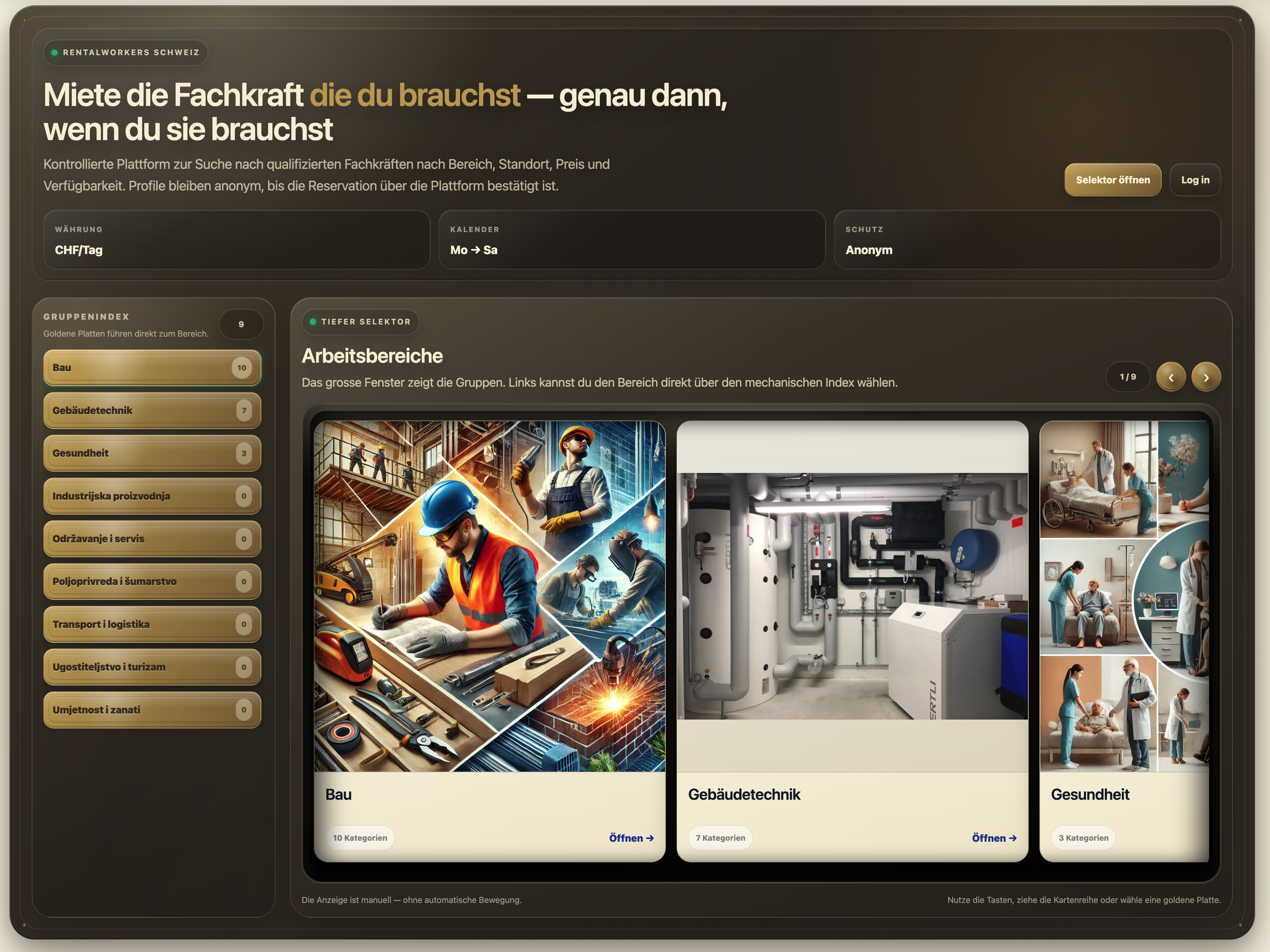
RentalWorkers is more than a catalogue of workers. Behind the public listings are vendor workflows, categories, qualifications, localized content, and different user journeys that all need to operate as one platform.
Next.js · Prisma · Multilingual · Marketplace · AI
Problem
The user sees a worker card. The system behind that card sees much more.
A worker belongs to the appropriate category, may have qualifications and a description, has an owner who can only manage their own listings, and the content needs to appear correctly in several languages.
As the platform grows, the catalogue, vendor workflows, and public frontend cannot evolve as three unrelated systems. They are different views of the same underlying data.
Challenges
The platform needs to understand the different needs of vendors offering workers and customers looking for the right person.
Groups, categories, qualifications, and profiles need enough structure for users to quickly reach relevant workers.
The Swiss market requires content that makes sense in German, French, and Italian, not just an interface translated mechanically.
Vendors need a simple way to create, edit, and maintain their workers and content without thinking about the internal structure of the system.
Descriptions, categories, qualifications, and other profile elements follow different rules and still need to remain consistent across the platform.
Automatic translation should speed up content creation without overwriting existing content that a person has already reviewed and edited.
Multilingual content
Vendors should be able to work naturally in their preferred language while the platform remains capable of presenting the appropriate localized content to users.
Translation therefore goes beyond interface labels. The actual data created and edited by vendors also needs to be localized.
Deutsch
Français
Italiano
AI translation workflow
The goal is not to let AI blindly rewrite everything every time a vendor clicks Save. The system needs to know what already exists, what is missing, and what a person has already chosen to keep.
Vendor
Works in the language selected for the vendor panel and edits the real worker content.
Save
The system stores the original content in the appropriate locale.
AI
Missing language versions can be prepared automatically in the background.
Protect
Existing manual translations remain preserved and are not overwritten unnecessarily.
Frontend
Users receive localized content in the appropriate language, with a defined fallback when needed.
AI fills in what is missing. It does not erase what a person has already created.
System
Worker groups and categories
Worker profiles and qualifications
Vendor management of their own listings
Multilingual content in DE / FR / IT
Localized worker cards and detail pages
AI-assisted generation of missing translations
Protection of existing manual translations
Marketplace and reservation user workflows
What this project demonstrates
DE / FR / IT
RentalWorkers shows how much a serious business application depends on consistency between the database, vendor panel, public frontend, user permissions, and localization.
AI is only one layer. It creates value only when it fits into a reliable existing workflow without disrupting what the user already controls.
Next case study
DAVO Technology requires a completely different way of thinking: the user is no longer sitting at a computer, but standing in front of a kiosk and interacting with the application by touch.
DAVO Technology →